In 2018, career advisors told anxious college students worried about automation to "learn data analysis" and "work with spreadsheets." The logic was seductive: if robots are taking factory jobs, move into the digital office. Be the person using technology instead of being replaced by it.
That advice aged like milk.
By 2024, ChatGPT could write SQL queries faster than most junior analysts. By 2025, AI agents were booking meetings, processing invoices, and summarizing reports—tasks that employed millions of "knowledge workers." The "safe" corporate jobs weren't safe at all. They were the first to fall.
The Pattern No One Saw Coming
Why did we get it so wrong? Because we confused complexity with irreplaceability.
Data analysis feels sophisticated. You need Excel skills, statistical knowledge, maybe some Python. It's not physically demanding, it pays well, and it requires a college degree. By every traditional metric, it should be automation-resistant.
But here's the brutal truth: if your job is primarily about processing structured information, you are in the blast radius.
Key Insight: AI doesn't replace "simple" jobs first. It replaces predictable jobs first. And many "complex" corporate jobs are shockingly predictable once you strip away the jargon.
The Three Moats: What Actually Protects You
After analyzing labor market data from O*NET (the U.S. Department of Labor's occupational database) and cross-referencing it with AI capabilities, a clear pattern emerged. Jobs with genuine automation resistance have at least one of three moats:
1. The Empathy & Trust Moat
Some jobs require human judgment in high-stakes situations where people demand a living person to be accountable. Examples:
- Therapists & Counselors: People in crisis need human empathy, not algorithmic responses
- Doctors & Surgeons: Medical decisions carry life-or-death weight—we want a human in the loop
- Lawyers (trial work): Juries trust human advocates, not chatbots
- Executive Leaders: Stakeholders demand human accountability at the top
Why it works: These roles involve emotional stakes, moral responsibility, or high-consequence decisions. Even if AI could technically do the task, society demands a human be present and accountable.
2. The Physical World Moat
Jobs requiring fine motor skills, spatial reasoning, and unpredictable physical environments remain expensive to automate. Examples:
- Electricians & Plumbers: Every building is different; troubleshooting requires improvisation
- Surgical Technicians: Assisting in surgery requires dexterity and real-time adaptation
- Dental Hygienists: Working inside a human mouth is physically complex and high-stakes
- HVAC Technicians: Diagnosing and fixing mechanical systems in varied environments
Why it works: Robotics is advancing, but physical automation is still orders of magnitude more expensive than software automation. A ChatGPT API call costs fractions of a cent. A robot that can navigate a crawl space and repair ductwork costs $200,000+.
3. The Chaos & Creativity Moat
Jobs requiring original synthesis, cultural intuition, or aesthetic judgment in ambiguous contexts. Examples:
- Creative Directors: Shaping brand identity requires cultural fluency and taste
- Architects: Designing spaces involves artistic vision and user empathy
- Investigative Journalists: Uncovering hidden stories requires source-building and narrative craft
- UX Researchers: Understanding why users behave in unpredictable ways
Why it works: AI can generate content, but it struggles with original judgment calls in ambiguous domains. It can write a press release but can't decide if a controversial ad campaign will backfire. It can analyze user data but can't intuit why a product "feels wrong."
The Data Reveal: The Great Inversion
When we run the U.S. labor market through our AI-Resistance algorithm—scoring occupations from 0 to 100 based on their physical, empathetic, and chaotic demands—the results blow the traditional corporate hierarchy wide open.
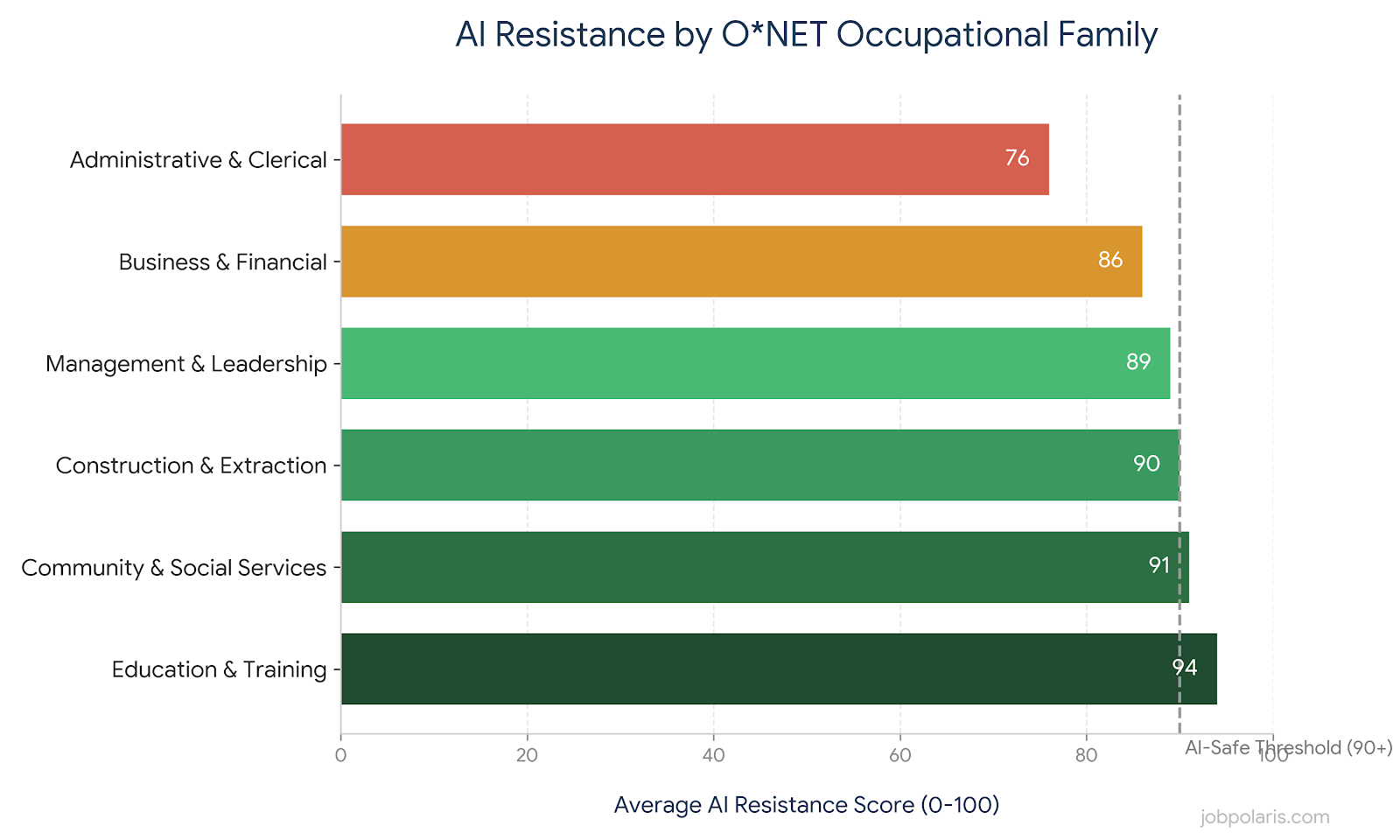
The exact job families society categorized as "risky" or "blue-collar" are actually the most future-proof careers in the modern economy. Look at the stark contrast in our data:
- Administrative & Clerical (SOC 43): 75.7 (High Automation Risk)
- Business & Financial Operations (SOC 13): 85.5 (The Danger Zone)
- Construction & Extraction (SOC 47): 89.7 (The Physical Moat)
- Social Services & Education (SOC 21 & 25): 90.8 - 93.9 (The Empathy Moat)
A traditional Accountant scores a 65.5 on the JobPolaris AI-Resistance Index. But a Plumber? 91.7. A Creative Director? 96.2. The hierarchy has completely inverted.
The Jobs That Lack Moats
Now let's look at roles getting automated right now—and notice what they're missing:
| Job Title | Why It's Vulnerable | Missing Moat(s) |
|---|---|---|
| Data Analyst | Queries, dashboards, and reports are structured workflows AI excels at | All three |
| Customer Service Rep | Scripted responses to common questions—chatbots handle 80% of queries | Human Trust, Creative Judgment |
| Bookkeeper | Invoice processing and reconciliation are deterministic tasks | All three |
| Paralegal (doc review) | Document analysis is pattern-matching—AI's strength | Human Trust, Creative Judgment |
| HR Coordinator | Scheduling, onboarding paperwork, policy Q&A—all automatable | All three |
Notice the pattern? These jobs involve structured information processing. They require skill and training, but they don't require human accountability, physical presence, or ambiguous creative judgment.
The Brutal Question You Need to Ask
If you work in a corporate office job, ask yourself:
"If I were hit by a bus tomorrow, could my employer replace 70% of my output with a $20/month AI subscription and a junior employee entering prompts?"
If the answer is yes, you don't have a moat. You have a temporary information asymmetry—and AI is closing that gap fast.
What This Means for Your Career
This isn't about fear-mongering. It's about strategic clarity. Here's what to do:
1. Audit Your Current Role
Which of the three moats does your job have? Be honest. If the answer is "none," start planning your transition now, not when the layoffs start.
2. Build Toward a Moat
If you're mid-career, consider pivoting into roles with at least one moat:
- From Data Analyst → UX Researcher: Trade dashboards for human insight
- From HR Coordinator → Organizational Development Consultant: Trade admin work for strategic people work
- From Bookkeeper → Financial Planner: Trade transaction processing for high-trust client relationships
3. If You're Starting Out, Choose Wisely
Don't choose a career based on current salaries. Choose based on automation resistance + growth potential + your psychological fit.
A 22-year-old today will work until 2070. The question isn't "what pays well in 2026?" It's "what will still exist—and pay well—in 2045?"
The Bottom Line
The automation wave isn't coming. It's here. And it's not taking the jobs we expected.
The "safe" corporate jobs—the ones that required degrees and paid well—are being automated faster than manufacturing ever was. Meanwhile, the jobs we looked down on—plumbers, electricians, therapists, skilled tradespeople—are proving shockingly resilient.
The future belongs to those who build moats. The question is: are you building one, or are you pretending your current job is a moat?